
Facial Self-Massage and Lymphatic Drainage — A Clinical Protocol for Airway Health
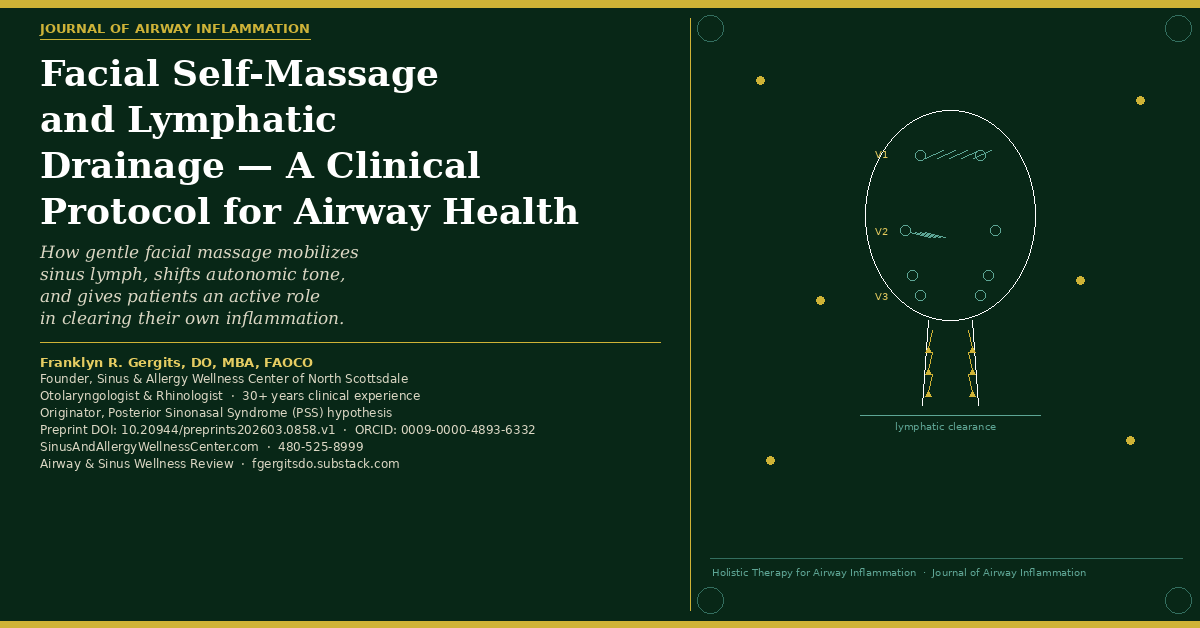
One of the most meaningful things I can give a patient is agency. Not just a prescription or a procedure, but a technique — something they can do themselves, at home, that actively supports their own healing. Facial self-massage and lymphatic drainage is exactly that. It is not a replacement for medical treatment. But as an adjunct to everything else we do — saline irrigation, allergy management, medication, surgery when indicated — it gives the patient a tool that works with the biology of the lymphatic and autonomic systems to help flush inflammation, mobilize fluid, and accelerate recovery.
In the context of this Holistic Therapy for Airway Inflammation series, facial massage is the natural companion to what we covered in the previous article on stress and the autonomic nervous system. That article established that parasympathetic activation is essential for immune function, mucosal health, and restorative sleep. This article shows patients exactly how to achieve that activation through their own hands.
Clinical education written for patients and providers. Subscribe to the Airway & Sinus Wellness Review.
Why Facial Massage Matters Clinically
The lymphatic system of the face and neck is the drainage infrastructure for the sinuses. Lymphatic vessels carry inflammatory mediators, cellular debris, and excess fluid away from the sinonasal tissue and through the cervical lymph node chain toward the thoracic duct, where they enter the venous system and are cleared from the body. When the lymphatic system is sluggish — as it often is in patients with chronic rhinosinusitis, allergy, or ongoing mucosal inflammation — this clearance slows. Fluid accumulates. Pressure builds. The inflammatory environment sustains itself.1
Gentle facial massage mechanically supports lymphatic flow by applying light, directional pressure that moves superficial fluid through the lymphatic vessels in the direction of drainage — outward from the center of the face and downward toward the cervical chain. This is not deep tissue work. The lymphatic vessels are superficial, and the pressure required to move fluid through them is feather-light. Heavy pressure does not produce more drainage — it compresses the vessels and can worsen symptoms.
The clinical value I see in practice is real. Patients who perform this protocol consistently — particularly morning and evening during a flare — report reduced facial pressure, a lighter feeling in the sinuses, and faster resolution of the congestion and fullness that accompanies acute inflammation. It helps flush the fluid. It helps mobilize the sinus lymph and glymph. It gives patients something concrete to do while the body heals.
The Autonomic Benefit — Why This Is More Than Just Drainage
Facial self-massage does something that patients do not always expect: it shifts the autonomic nervous system from sympathetic dominance toward parasympathetic activation. The trigeminal nerve — which innervates the face through its three major branches — has direct connections to the autonomic nervous system, and gentle stimulation of the facial tissue over these branches activates parasympathetic pathways that reduce systemic stress tone, slow the heart rate, and create the physiological conditions for recovery and repair.2
This is why I teach facial massage in the context of stress reduction as well as lymphatic drainage. The technique accomplishes both simultaneously. When combined with 4-7-8 breathing — inhale four counts, hold seven, exhale eight — the autonomic shift is deepened further. The patient who performs facial massage while breathing slowly and deliberately is not just moving lymphatic fluid. They are actively downregulating the sympathetic nervous system that has been sustaining the inflammatory environment in the airway.
The Six-Step Drainage Sequence
The foundational principle is feather-light pressure throughout. The lymphatic vessels that carry facial fluid are superficial — they sit just beneath the skin — and they respond to light, rhythmic, directional contact. Pressing harder does not improve results and can cause dizziness or discomfort. If any step causes worsening pain, dizziness, or nausea, stop immediately.
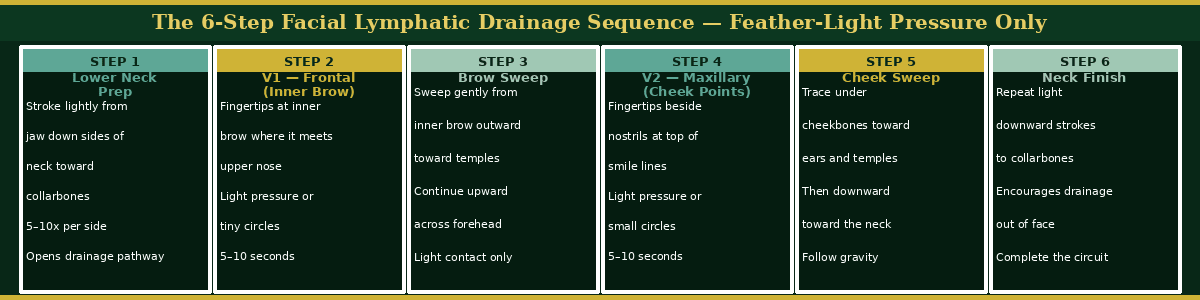
Begin at the lower neck. Before touching the face, open the downstream pathway. Lightly stroke from just below the jaw down both sides of the neck toward the collarbones, five to ten times per side. This clears the receiving end of the drainage system so that fluid moved from the face has somewhere to go.
Move to the V1 region — the frontal area. Place the fingertips at the inner eyebrow where the brow meets the upper nose. Apply very light pressure or tiny circular movements for five to ten seconds. This stimulates the ophthalmic branch of the trigeminal nerve and initiates drainage from the frontal sinus region.
Perform the brow sweep. Sweep gently from the inner brow outward toward the temples, then continue slightly upward across the forehead. Use the lightest possible contact — the goal is to move fluid laterally and toward the temporal drainage pathway, not to press into the tissue.
Move to the V2 region — the maxillary area. Place the fingertips at the top of the smile lines beside the nostrils. Apply very light pressure or small circles for five to ten seconds. This stimulates the maxillary branch and initiates drainage from the maxillary sinus region — the most commonly affected sinus in chronic rhinosinusitis.
Perform the cheek sweep. Gently trace under the cheekbones toward the ears and temples, then continue the stroke downward toward the neck. Follow gravity. The fluid moves from the center of the face, outward, and then downward toward the cervical lymph chain.
Finish at the neck again. Repeat the light downward strokes from below the jaw to the collarbones that began the sequence. This completes the drainage circuit — fluid mobilized from the face moves into the cervical chain and toward systemic clearance.
The sequence below maps all six steps with the trigeminal nerve zones, pressure technique, and timing for each. Feather-light pressure is the single most important variable — the sequence does not work with heavy pressure and can worsen symptoms if applied incorrectly.
When to Use It — Timing and Frequency
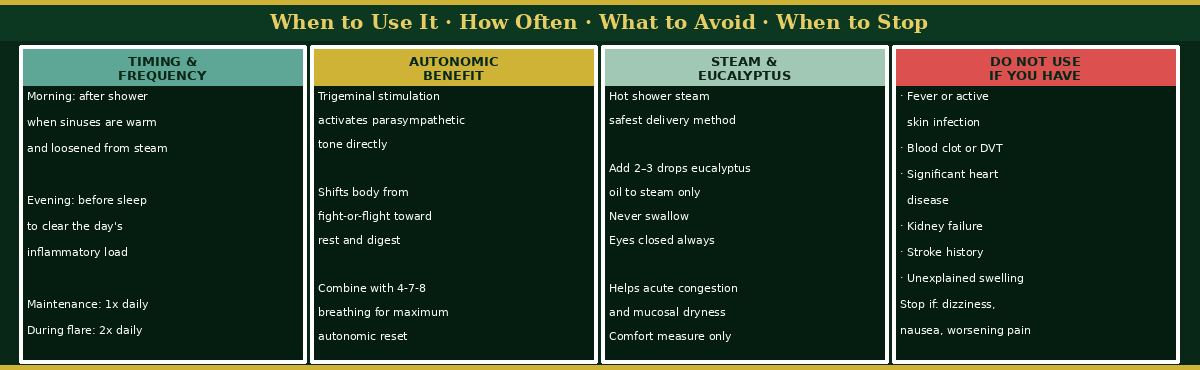
The most effective timing for facial massage in airway disease is immediately after a hot shower in the morning. The steam from the shower has already warmed and loosened the sinonasal tissue, the mucosal secretions are more mobile, and the parasympathetic activation from the warm water has primed the system for further drainage. Five to ten minutes of the sequence at this point, combined with saline irrigation, gives the morning routine a powerful compounding effect.
The second most effective timing is in the evening before sleep. Clearing the day’s accumulated inflammatory load from the facial lymphatic system before entering sleep supports the glymphatic clearance that occurs during slow-wave sleep — the brain’s overnight waste removal system that depends on a relaxed, parasympathetically dominant state.3 Evening massage combined with 4-7-8 breathing is one of the most effective pre-sleep routines I know of for patients with chronic airway inflammation.
For maintenance — during asymptomatic periods — once daily is adequate. During an acute flare, twice daily produces meaningful clinical benefit. The single most common error patients make is inconsistency. The technique works best as a daily practice, not an occasional intervention.
Steam and Eucalyptus — A Useful Adjunct
Steam inhalation is a well-established home comfort measure for sinus pressure and nasal dryness. The safest delivery method is a hot shower — the steam is consistent, the temperature is controlled, and there is no risk of burns from leaning over a bowl of hot water. For patients who want to enhance the steam experience, two to three drops of eucalyptus oil in the shower can provide a stronger subjective sense of decongestion. The oil should never be swallowed, eyes should remain closed, and patients with asthma or known sensitivity to essential oils should use extreme caution or avoid it entirely.
Eucalyptus is a comfort measure, not a treatment. It does not cure infection or resolve structural obstruction. But as an adjunct to the massage sequence and saline irrigation, it adds to the subjective sense of relief that motivates patients to maintain the routine.
The reference guide below covers the full clinical picture — optimal timing, the autonomic benefit, steam and eucalyptus guidance, and the contraindications that must be reviewed before any patient begins the protocol. The contraindications column is not optional reading — these are genuine clinical safety considerations.
Dr. G’s Clinical Pearls
Pearl 1
Feather-light pressure is not a suggestion — it is the technique. The lymphatic vessels that carry facial fluid are superficial and respond to light, rhythmic contact. Pressing harder does not produce more drainage. It compresses the vessels and can worsen symptoms. If a patient tells me the massage made their face hurt, the pressure was wrong.
Pearl 2
Always open the downstream pathway first. Beginning the sequence at the lower neck — stroking from below the jaw toward the collarbones — clears the receiving end of the drainage system before fluid is moved from the face. Without this step, you are moving fluid toward a closed valve.
Pearl 3
The autonomic benefit is real and clinically significant. Trigeminal stimulation through gentle facial massage shifts the body from sympathetic dominance toward parasympathetic activation. Combined with 4-7-8 breathing, this technique is one of the most accessible and effective autonomic reset tools available to patients — and it doubles as lymphatic drainage simultaneously.
Pearl 4
Consistency is the only variable that matters long-term. Patients who do this once when they feel terrible and then stop see minimal benefit. Patients who build it into the morning shower routine and the pre-sleep ritual — maintenance once daily, twice during flares — report genuinely meaningful improvement in their symptom burden over time. Give them a protocol, not a suggestion.
References
-
Chikly B. Silent Waves: Theory and Practice of Lymph Drainage Therapy. Scottsdale, AZ: I.H.H. Publishing; 2001.
-
Zaccaro A, Piarulli A, Laurino M, et al. How breath-control can change your life: a systematic review on psycho-physiological correlates of slow breathing. Front Hum Neurosci. 2018;12:353.
-
Xie L, Kang H, Xu Q, et al. Sleep drives metabolite clearance from the adult brain. Science. 2013;342(6156):373-377.
-
Gergits FR. The Sinus Is the Victim, Pepsin Is the Perpetrator: Posterior Sinonasal Syndrome as the Etiological Precursor to Chronic Rhinosinusitis. Preprints. 2026. doi:10.20944/preprints202603.0858.v1
Want to Understand More?
This post is part of the Journal of Airway Inflammation — Holistic Therapy for Airway Inflammation series on the Airway & Sinus Wellness Review.
Stress, the Autonomic Nervous System, and Airway Inflammation
The Osteopathic Airway — Structure, Function, and the Whole Patient
FAQ: Why Antibiotics Keep Failing Your Sinus Infection
The Final Chapter: What the Field Still Cannot See — Posterior Sinonasal Syndrome
Journal of Airway Inflammation — Holistic Therapy for Airway Inflammation · Airway & Sinus Wellness Review · fgergitsdo.substack.com
About the Author
Franklyn R. Gergits, DO, MBA, FAOCO is an osteopathic physician, otolaryngologist, and rhinologist with over 30 years of clinical experience. He is the founder of the Sinus & Allergy Wellness Center of North Scottsdale and performed the first balloon sinuplasty in Pennsylvania. He holds dual Entellus Centers of Excellence certifications and specializes in office-based nasal and sinus procedures under local anesthesia, including balloon sinuplasty, turbinate reduction, NEUROMARK® posterior nasal nerve ablation (Neurent Medical, FDA-cleared radiofrequency ablation system), and Eustachian tube dilation. Dr. Gergits is the originator of the Posterior Sinonasal Syndrome (PSS) hypothesis, with a preprint available at Preprints.org (DOI: 10.20944/preprints202603.0858.v1). ORCID: 0009-0000-4893-6332.
SinusAndAllergyWellnessCenter.com · 480-525-8999
This content is for educational purposes only and does not constitute medical advice. The techniques described are intended for adults without contraindications. If you are experiencing severe, worsening, or unexplained symptoms, please consult a qualified physician before beginning any self-care protocol.
Disclaimer:
The information provided in this article is for informational and educational purposes only and does not constitute medical advice. It is not intended to diagnose, treat, cure, or prevent any disease or medical condition. Always seek the guidance of your physician or other qualified healthcare provider with any questions you may have regarding a medical condition or treatment.
Results may vary: Treatment outcomes and health experiences may differ based on individual medical history, condition severity, and response to care.
Emergency Notice: If you are experiencing a medical emergency, call 911 or seek immediate medical attention.