
NEUROMARK® vs ClariFix® vs RhinAer® — What Is the Difference?
NEUROMARK® (Neurent Medical), ClariFix® (Stryker), and RhinAer® (Aerin Medical/Stryker) all target the posterior nasal nerve for chronic rhinitis treatment — but they use different energy modalities, reach different anatomical territories, and carry different risk and durability profiles. SAWC performs NEUROMARK® exclusively. We do not use ClariFix or RhinAer.
By Dr. Franklyn Gergits, ENT · Sinus & Allergy Wellness Center of North Scottsdale · SinusAndAllergyWellnessCenter.com
If you have researched posterior nasal nerve treatment online, you have encountered three device names: NEUROMARK®, ClariFix®, and RhinAer®. All three are FDA-cleared. All three target the posterior nasal nerve. All three are marketed for chronic rhinitis with excessive post-nasal drainage, runny nose, and congestion. And all three produce results that patients report as meaningful.
So why does the choice of device matter — and why does SAWC use NEUROMARK® exclusively?
Thanks for reading Airway & Sinus Wellness Review. Subscribe free to receive new posts and support this work.
The Three Devices — A Brief Overview
ClariFix® was the first to market, FDA-cleared in 2017. It uses cryotherapy — liquid nitrogen delivered via an inflatable balloon placed endoscopically into the sphenopalatine ganglion region. The balloon is inflated, freezing the nerve tissue, and then removed. The mechanism is ablation through extreme cold rather than heat.
RhinAer® uses temperature-controlled radiofrequency energy delivered through a point-contact stylus tip. It targets the posterior nasal nerve at the sphenopalatine foramen and the posterior lateral nasal wall. RhinAer is manufactured by Aerin Medical, which was acquired by Stryker — the same company that makes ClariFix. Both devices are now in the Stryker portfolio.
NEUROMARK® uses temperature-controlled radiofrequency energy delivered through curved wire paddles rather than a point-contact tip. It is manufactured by Neurent Medical, an independent company. SAWC has no financial relationship with Neurent Medical.
Energy Modality — Radiofrequency vs Cryotherapy
The most fundamental difference is between radiofrequency energy and cryotherapy — the technologies used by NEUROMARK® and RhinAer® on one side, and ClariFix® on the other.
A published meta-analysis comparing the two modalities found that radiofrequency neurolysis was significantly more effective than cryotherapy in reducing total nasal symptom scores, with particularly superior results for rhinorrhea, congestion, and itching at up to 12 months of follow-up. A separate multicenter cohort study found that after ClariFix® cryoablation, 95% of patients experienced some degree of rhinorrhea recurrence by a mean of five months post-procedure, with 65% returning completely to their preoperative symptom levels. By contrast, the three-year published data for temperature-controlled radiofrequency shows sustained 57.7% improvement in total nasal symptom scores, with 80% of patients maintaining clinically meaningful benefit at two years.
There is also a safety consideration specific to ClariFix®. Patients who receive cryotherapy with insufficient pre-procedural anesthesia can experience severe, intense cephalgia — an acute and painful headache triggered by the cold delivery. This risk profile is not present with radiofrequency devices. At SAWC, our pre-procedural anesthesia protocol is extensive and deliberate precisely because patient comfort is a clinical priority — but the radiofrequency modality we use does not carry the cryotherapy-specific risk regardless.
Surface Area and Anatomical Reach — Where the Devices Differ Most
The second meaningful difference is in the surface area treated per energy delivery and the anatomical territory each device can reach.
RhinAer® uses a point-contact stylus. Accurate placement at the precise nerve location is required for effective treatment — the contact area is small, and precise positioning matters. NEUROMARK®’s curved wire paddle design covers significantly more mucosal territory per treatment position. The larger surface area means that less positional precision is required and coverage is more complete — the energy reaches the nerve network across a broader region rather than requiring a bullseye placement.
More importantly, NEUROMARK®’s paddle design allows treatment to extend inferior along the posterior lateral nasal wall and into the posterior nasopharynx — territory that ClariFix® and RhinAer® cannot anatomically access. This posterior nasopharyngeal reach is what enables treatment of the peripheral branches of the posterior nasal nerve and the adjacent trigeminal nerve bundle in that region. It is why NEUROMARK® patients with Eustachian tube dysfunction report ear symptom improvement that ClariFix® and RhinAer® patients do not consistently experience — the device is reaching the nerve branches that serve the Eustachian tube orifice.
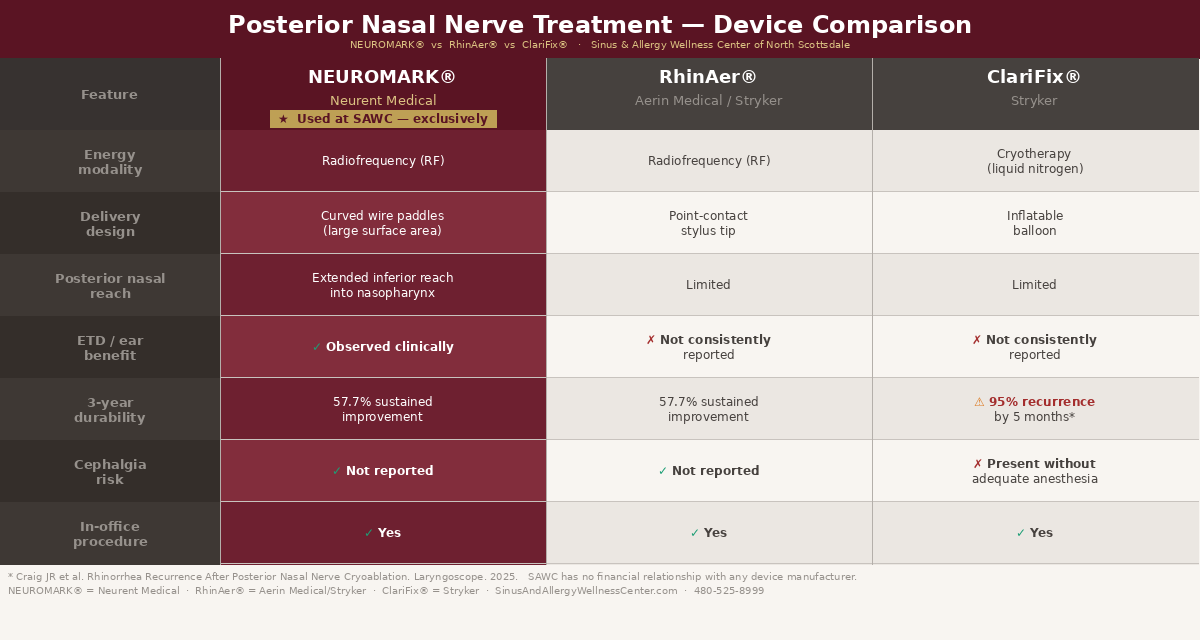
“The differences summarized above translate directly into the clinical decision SAWC made when selecting a device for our procedure suite.”
Putting It Together — The Differences That Matter
All three devices are FDA-cleared and all three produce results that patients report as meaningful. But when you look at the evidence closely, the differences are not subtle.
On energy modality, NEUROMARK® and RhinAer® both use radiofrequency energy. ClariFix® uses cryotherapy — liquid nitrogen delivered through an inflatable balloon. The published meta-analysis comparing these two approaches found radiofrequency significantly more effective at reducing total nasal symptom scores, with particular advantages in rhinorrhea, congestion, and itching at up to 12 months. A multicenter cohort study found that 95% of ClariFix® patients experienced some degree of symptom recurrence by a mean of five months, with 65% returning completely to their preoperative baseline. The three-year radiofrequency data shows 57.7% sustained improvement with 80% of patients maintaining meaningful benefit at two years. That is not a small difference for a patient deciding between procedures.
On delivery design, RhinAer® uses a point-contact stylus that requires precise placement at the nerve location. NEUROMARK®’s curved wire paddles cover significantly more mucosal surface area per treatment position — less precision required, more territory covered. More importantly, the paddle design extends inferior into the posterior nasopharynx, reaching nerve branches that neither RhinAer® nor ClariFix® can anatomically access. That extended reach is what produces the Eustachian tube benefit we observe clinically at SAWC — and it is a reach the other two devices simply do not have.
On safety, both radiofrequency devices are free of the cephalgia risk that ClariFix® carries when pre-procedural anesthesia is insufficient. That is not a theoretical risk — it is documented and it is one of the reasons we do not use cryotherapy at SAWC.
Why SAWC Uses NEUROMARK® Exclusively
The decision to use NEUROMARK® exclusively at SAWC reflects a clinical judgment about which device best serves the patient population we treat. Our patients frequently present with a combination of posterior drainage, Eustachian tube dysfunction, and symptoms that point to posterior nasal nerve overactivation as part of a broader posterior sinonasal inflammatory pattern. The extended anatomical reach of NEUROMARK®, combined with its radiofrequency modality and the superior three-year durability data for that modality class, makes it the best available tool for that clinical picture.
We also considered the published recurrence data for cryotherapy carefully. A procedure that produces meaningful initial results but returns 65% of patients to their preoperative baseline within five months is not a long-term solution for a chronic condition. Our patients deserve durable results — and the radiofrequency data supports that expectation.
SAWC has no financial relationship with Neurent Medical. We use NEUROMARK® because the clinical evidence supports it as the superior choice for our patient population.
Want to Understand More?
This post is part of the Understanding Your Symptoms series on the Airway & Sinus Wellness Review.
→ What Is NEUROMARK® — and Could It Stop Your Chronic Runny Nose?
→ Does Balloon Sinuplasty Actually Work?
→ Will Balloon Sinuplasty Correct My Post-Nasal Drainage?
→ Is the Combination Procedure Too Much?
→ Airway & Sinus Wellness Review — Full Publication
Understanding Your Symptoms — Clinical education from the Sinus & Allergy Wellness Center of North Scottsdale.
About the Author
Dr. Franklyn R. Gergits, DO, MBA, FAOCO is an osteopathic otolaryngologist and otolaryngic allergist with a focus in rhinology with over 30 years of clinical experience treating sinus and airway disease in Scottsdale and the greater Phoenix metropolitan area. He is the founder of the Sinus & Allergy Wellness Center of North Scottsdale and performed the first balloon sinuplasty in Pennsylvania. He holds dual Entellus Centers of Excellence certifications and specializes in comprehensive, personalized, office-based nasal and sinus care — including balloon sinuplasty, NEUROMARK® posterior nasal nerve treatment, Eustachian tube dilation, nasal airway surgery, and comprehensive allergy testing and immunotherapy. Dr. Gergits is the originator of the Posterior Sinonasal Syndrome (PSS) hypothesis — a clinical framework identifying pepsin-mediated posterior nasal mucosal injury as an upstream driver of chronic rhinosinusitis. ORCID: 0009-0000-4893-6332. Preprint DOI: 10.20944/preprints202603.0858.v1. Dr. Gergits has no financial relationship with Neurent Medical.
SinusAndAllergyWellnessCenter.com · 480-525-8999
This content is for educational purposes only and does not constitute medical advice. Please consult a qualified physician for evaluation and treatment of your specific condition. NEUROMARK® is a registered trademark of Neurent Medical. ClariFix® is a registered trademark of Stryker. RhinAer® is a registered trademark of Aerin Medical, Inc. Dr. Gergits has no financial relationship with any device manufacturer mentioned in this article.
Disclaimer:
The information provided in this article is for informational and educational purposes only and does not constitute medical advice. It is not intended to diagnose, treat, cure, or prevent any disease or medical condition. Always seek the guidance of your physician or other qualified healthcare provider with any questions you may have regarding a medical condition or treatment.
Results may vary: Treatment outcomes and health experiences may differ based on individual medical history, condition severity, and response to care.
Emergency Notice: If you are experiencing a medical emergency, call 911 or seek immediate medical attention.